Blue light does not whiten teeth by itself. The whitening comes from a peroxide gel, and the light is an optional extra that is meant to speed up the gel’s reaction. Recent reviews of the clinical evidence suggest the light adds little to the final result, and in some cases it may increase sensitivity. If you want a noticeably whiter smile, the strength of the gel and who applies it matter far more than the colour of the lamp.
This guide explains what blue and LED whitening lights actually do, what the research says, where the safety risks sit in Australia, and how to decide between a home kit and a professional session.
TL;DR
- Blue and LED lights do not whiten teeth on their own. The peroxide gel does the work.
- Reviews of in-office studies, including one published in 2026, found light activation generally does not improve final whitening and may raise sensitivity.
- In Australia, the Australian Dental Association says products stronger than 6% hydrogen peroxide should only be supplied or used by registered dental practitioners.
- Home LED kits are low-strength, so results are modest. A professional session with a stronger gel and a proper consultation is the more reliable route.
- Skip whitening, or see a dentist first, if you are pregnant, have gum disease, untreated decay, or crowns, veneers and fillings in the front teeth.
Table of Contents
- What blue light teeth whitening actually is
- Does blue light whiten teeth on its own?
- Does the light make whitening faster or better?
- What results can you realistically expect?
- Is blue light whitening safe?
- Home LED kits versus professional whitening
- How to decide: a quick checklist
- Professional whitening at SmileBar
- Questions to ask any whitening provider
- FAQ
What blue light teeth whitening actually is
Blue light whitening pairs a whitening gel with an LED lamp that emits light at around the blue end of the spectrum. You will see it in two settings: a lamp held over your teeth during a clinic appointment, and a small mouthpiece or handheld LED that comes in a home kit.
The idea is simple. The gel contains hydrogen peroxide or carbamide peroxide, which releases oxygen that breaks down the stain molecules inside the tooth. The light is said to energise the gel, so it reacts faster. That is the marketing claim behind almost every LED kit on the shelf.
The gap between the claim and the evidence is where most of the confusion comes from. Gel without light whitens. Light without gel does not. Colgate’s explainer on LED whitening makes the same point: LED whitening relies on a peroxide solution together with the light, and the light alone does nothing.
Does blue light whiten teeth on its own?
No. A clinical study from Brazil on violet LED light found that the light used alone produced the lowest whitening effect of the groups tested. It only enhanced results when it was combined with hydrogen peroxide in an in-office protocol.
That matches what a dentist would tell you in the chair. Shining a lamp at stained teeth without a gel is like heating a pan with no food in it. Something is happening, but it is not cooking.
This is also why the “free” light in a cheap kit is not the selling point it looks like. If the gel in the kit is weak, no lamp will turn it into a professional result.
Does the light make whitening faster or better?
This is the question that matters, and the current research is not kind to the marketing.
A 2026 umbrella review of in-office bleaching protocols (a review that pools the findings of other reviews) concluded that light activation, whether LED, halogen or laser, generally does not improve whitening efficacy. It also noted that light may, in some cases, increase tooth sensitivity. A separate 2026 review of laser and light activation reached a similar position: current evidence does not support routine use of light to improve bleaching outcomes, and it found no consistent improvement in final results compared with protocols that did not use light.

Older literature points the same way. A review covering studies from 2003 to 2013 found conflicting evidence on light activation, with some studies showing no gain in either efficacy or speed.
There is one nuance worth knowing. Some limited 2025 research suggests violet light combined with carbamide peroxide may enhance whitening without increasing sensitivity. The 2026 umbrella review treats that evidence as limited and says it needs cautious interpretation. So the honest summary is that the light may help a little in certain setups, but it is not what separates a good whitening result from a poor one.
What actually drives the result
If the lamp is not the main factor, what is? In practice, five things:
- Gel strength. Higher peroxide concentrations act faster, though the 2026 umbrella review found that moderate concentrations (25 to 35% hydrogen peroxide) gave comparable whitening to higher ones with less sensitivity. More is not always better.
- Contact time. How long the gel stays on the teeth, and how many applications are done in the session.
- Your starting shade and the type of stain. Coffee, tea and red wine stains respond well. Grey tetracycline staining or fluorosis responds less predictably. If you have fluorosis, this guide to fluorosis whitening explains why bleaching alone can fall short.
- The condition of your teeth. Whitening only changes natural tooth structure.
- How well the gel is applied and protected from your gums. This is the part that needs training.
Notice what is missing from that list: the colour of the light.
What results can you realistically expect?
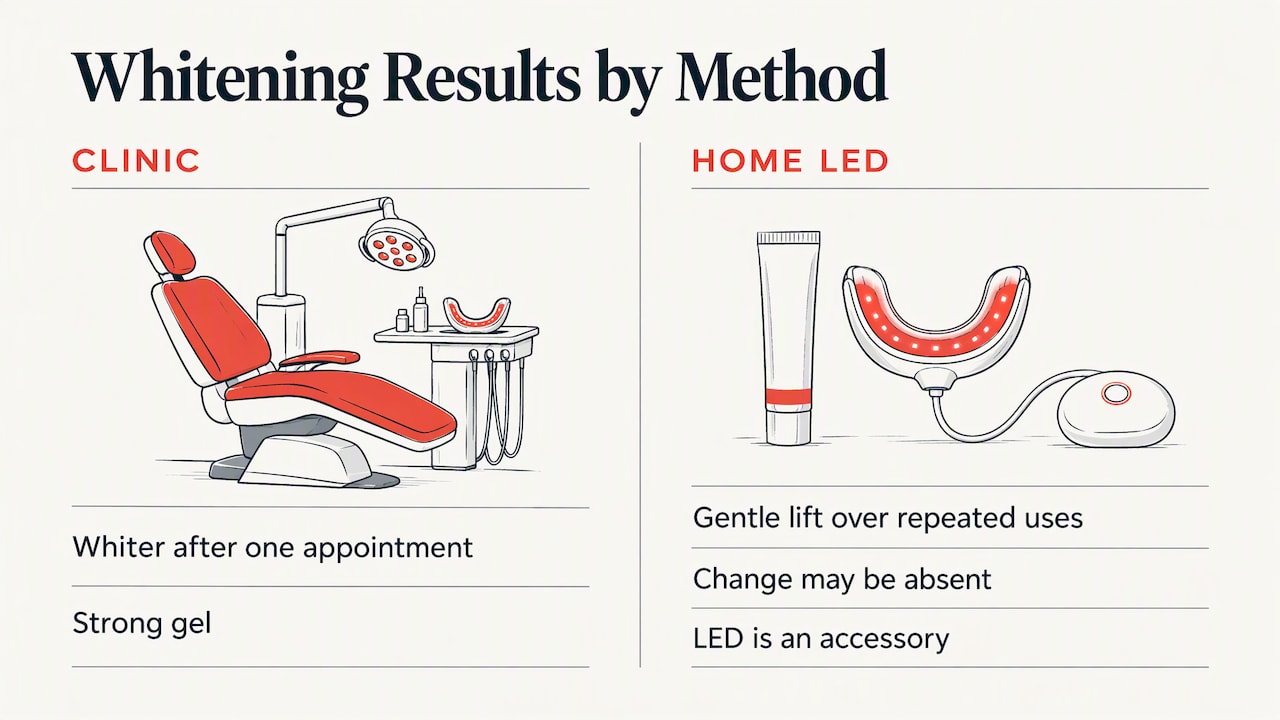
The fair answer is that it depends on your teeth, and no honest provider can promise a specific shade jump in advance. Healthdirect, the Australian government health information service, notes that professional whitening can leave you with whiter teeth after one appointment. That is the realistic benchmark: one session in a clinic, using a strong gel, can make a visible difference.
Home LED kits sit well below that. Because the gel in a consumer product has to stay at a low concentration, you are usually looking at a gentle lift over repeated uses, if you notice a change at all. Dentists commonly describe the blue LED in these kits as an accessory rather than the active part of the treatment.
If you drink a lot of coffee or red wine, expect stains to return over time regardless of method. Our guide to keeping your results after whitening covers what helps, and what to eat after whitening is worth a read before your appointment.
Is blue light whitening safe?
The gel is the larger safety question, and the light is a smaller one. Here is how the risks break down.
Risks from the light and heat
The Australian Dental Association’s policy on whitening by persons other than dental practitioners warns that incorrect application of heat or other forms of energy during whitening may cause nerve damage to the tooth and burns to nearby soft tissue. It also points to AS/NZS 4173:2018, the Australian and New Zealand standard on the safe use of lasers and intense light sources in health care, which sets requirements, including training standards, for dental practices and the cosmetics industry.
A small consumer LED mouthpiece is a long way from a clinical laser, but the principle holds: energy aimed at teeth and gums should be used by someone trained to do it.
Sensitivity
Sensitivity is the most common complaint after whitening. The 2026 umbrella review suggests that adding light may, in some cases, make it worse, not better. Interestingly, the same review identifies photobiomodulation, a different, low-level light therapy, as a possible adjunct for reducing sensitivity in people who are prone to it. That is a separate application and not what a standard whitening lamp does.
If you already know your teeth zing with cold drinks, read our pages on whitening sensitive teeth, whether whitening hurts and the common causes of tooth sensitivity before you buy any kit.
Gel and gum damage
The ADA’s policy on direct-to-consumer and do-it-yourself dentistry lists risks from DIY whitening kits including gum damage, mouth ulcers, stomach issues, and potential nerve damage if the product is applied to teeth with existing cavities. None of those risks come from the light. They come from using peroxide without anyone checking your mouth first.
Who should get dental advice first
Healthdirect says whitening is not recommended if you are pregnant or breastfeeding, have gum disease, have sensitive teeth, or have untreated dental problems. If any of that applies, see your dentist before booking anything. Our page on pregnancy and teeth whitening explains why dentists suggest waiting.
Two more situations to know about:
- Crowns, veneers and fillings. Healthdirect notes that whitening will not change these. If your front teeth have restorations, whitening natural teeth around them can leave a visible mismatch.
- Children. Whitening is generally not something to do on young teeth. See our guide on whitening children’s teeth.
If you have a single dark tooth that has had root canal treatment, that is a different problem again, and internal bleaching may be the right approach.
Home LED kits versus professional whitening
The ADA’s position is that only registered dental practitioners, who are trained and competent, should supply or use whitening products with more than 6% hydrogen peroxide or equivalent. That single rule explains most of the gap between home and professional results.
| At-home LED kit | Professional in-clinic session | |
|---|---|---|
| Gel strength | Low, limited by Australian rules | Higher strength, applied by a trained operator |
| Role of the light | Marketed as the key feature | Optional, and not what drives the result |
| Time to see a change | Repeated uses over days or weeks | Often visible after one appointment |
| Oral check beforehand | None | Consultation to check suitability |
| Gum protection | You do it yourself | Done for you |
| Main risks | Poor fit, gum irritation, misuse | Sensitivity, managed by technique and aftercare |
The ADA also notes that dental practitioners can supply professional products and custom-fitted trays for home use under their guidance, and can assess whether bleaching is safe for you in the first place. Healthdirect is blunt on the bottom line: the safest and most effective whitening is given by a dental professional, so talk to them about the benefits and your chances of harm.
If you want the longer argument, we have written about why professional whitening matters.
What about the “least toxic” way to whiten?
People often ask for a gentle, natural option. There is no peroxide-free method that matches peroxide results, and charcoal powders and homemade pastes can be abrasive. The practical answer from the evidence is a controlled, moderate-strength gel applied properly, which the 2026 umbrella review found can match stronger concentrations with less sensitivity. Controlled professional treatment is usually less risky than guesswork at home.
How to decide: a quick checklist
Work through these before you spend money on a lamp or a kit.
- Are your teeth and gums healthy? If you have decay, gum disease or an old filling you are unsure about, book a check-up first.
- Do you have restorations on visible teeth? Whitening will not match them to your natural teeth.
- How fast do you need the result? If you have a wedding, a job interview or a holiday coming up, a single professional session is more dependable than weeks of a home kit. Whiten at least a few days beforehand so any sensitivity settles.
- How sensitive are your teeth? Choose an operator who will talk about sensitivity in the consultation, not after.
- Do you want the result to last? Plan for maintenance either way. Our guide on how often to whiten and our page on how many sessions you need set sensible expectations.
Professional whitening at SmileBar
We built SmileBar around the part of whitening that does the work: the gel, the technique and the consultation. We use the highest-grade whitening gel allowed by law, and we tailor each session to your teeth, with a focus on keeping sensitivity to a minimum. Since 2011 we have completed more than 10,000 treatments.
There are two session options:
- Triple Action, 60 minutes: $199
- Ultra Bright, 90 minutes: $249, our signature intensive session for the whitest yet natural-looking result
You can see how a visit runs on our treatments page, or book a session on the SmileBar homepage. We also sell gift vouchers, which suit birthdays and anniversaries, and couples can book side by side without sharing trays. If you are on the Gold Coast, our Gold Coast page lists locations, and we also have studios in Noosa, Maroochydore, Townsville and Goodwood in Adelaide.
Prices were last checked on our site in October 2026. Confirm the current price at booking.
Questions to ask any whitening provider
Whether you choose us or someone else, a good provider should be able to answer these without hesitation:
- What concentration of gel do you use, and is it legal for you to use it?
- What training does the operator have?
- Will you check my teeth and gums before starting?
- What do you do to protect my gums and reduce sensitivity?
- What aftercare will I get in writing?
Vague answers, or a pitch built mostly around a special light, are a reason to look elsewhere.
FAQ
Does blue light whitening work?
Only in combination with a whitening gel. Light alone does not whiten teeth, and reviews of in-office studies, including a 2026 umbrella review, found light activation generally does not improve final results. Any whitening you get from a kit comes mainly from the peroxide in the gel.
Do LED whitening lights work in home kits?
They may make the kit feel more like a clinic treatment, but the evidence does not show the light is what whitens. Home kits also use low-strength gel, so the change is usually modest and gradual. A professional session uses stronger gel and typically gives a more visible result in one visit.
Is blue light whitening safe?
Used properly, it is generally low risk, but the Australian Dental Association warns that incorrect use of heat or other energy can damage the tooth nerve and burn soft tissue. Sensitivity is the most common side effect, and light may add to it. If you are pregnant, have gum disease, untreated decay or very sensitive teeth, speak to a dentist before whitening.
Can blue LED light whiten teeth without gel?
No. A clinical study found that LED light used alone produced the lowest whitening effect. It only added to the result when used together with hydrogen peroxide in a clinic protocol.
Will whitening work on crowns, veneers or fillings?
No. Healthdirect notes that whitening does not change crowns, veneers or fillings, so they can end up a different shade from your whitened natural teeth. Talk to your dental professional about the options before you start.
Recommended
- Are Teeth Whitening Strips Safe? Find Out Here
- The Safe Way to Use At-Home Teeth Whitening
- Teeth Whitening: Key Facts Before Treatment
- Why Choosing A Professional Teeth Whitening Is Important