Professional whitening gives you the shade. Keeping it comes down to a few habits: what you eat and drink in the first few days, how you brush, how you handle coffee and red wine, and a light touch-up every so often. Do those well and most people hold their result for a year or more. Skip them and the shade drifts back faster than it needs to.
This guide covers what to do, in order, from the day of your session. It also covers when a top-up makes sense and what no routine can fix.
TL;DR
- Avoid strongly coloured food and drink for at least 72 hours after your session. A full week is better.
- Brush twice a day with fluoride toothpaste and a soft brush, floss daily, and wait about an hour after coffee or wine before brushing.
- Treat the whitening toothpaste aisle with caution. Abrasive or charcoal formulas can leave teeth rougher and easier to stain.
- Plan a short top-up every 6 to 12 months, rather than waiting until you hate the shade.
- Crowns, veneers and fillings do not whiten, so they will not move with your natural teeth.
Table of Contents
- How long do whitening results last?
- The first 72 hours: the window that matters most
- A daily routine that protects the shade
- Coffee, red wine and other stain culprits
- Choosing toothpaste: whitening is not always whiter
- Touch-ups: when and how
- Re-staining: what is normal and what is not
- What maintenance cannot fix
- Treat it like any professional treatment
- Our perspective on keeping a whitening result
- Book a session or a top-up
- FAQ
- Sources
How long do whitening results last?
There is no single number. A systematic review of home bleaching studies found that most authors report colour staying stable between one and two and a half years. It also found that severe discolouration, such as tetracycline staining, tends to return more often.
That range is wide because teeth do not “un-whiten”. Whitening lifts stains out of the enamel. Over time, new pigment from food, drink, tobacco and plaque builds up on the surface and in the tiny pores of the enamel. How quickly that happens depends on:
- how much coffee, tea, red wine, cola or dark sauce you consume
- whether you smoke or vape
- how thoroughly you clean between your teeth
- how rough your enamel surface is, which toothpaste and brushing technique both affect
- your starting point, since deeply stained teeth rebound more
So the honest answer to “how long will it last?” is: longer than a few months if you look after it, and roughly a year is a sensible planning figure.
The first 72 hours: the window that matters most
After whitening, your teeth are clean and receptive. Dental practitioners generally advise avoiding strongly pigmented food and drink for at least 72 hours, and extending that to about a week gives the best protection for your result.
For those first days, think “white diet”:
- Safe choices: water, milk, chicken, fish, white rice, pasta with cream or butter, potato, cauliflower, bananas, white bread, plain yoghurt, cheese.
- Avoid: coffee, black tea, red wine, cola, berries, tomato sauce, soy sauce, curry, balsamic, beetroot, dark chocolate.
- Avoid completely: smoking and vaping.
If you cannot give up coffee, switch to a very milky one, drink it through a straw and rinse with water straight afterwards. It is not perfect, but it limits contact with your front teeth. We have a longer rundown in our guide on what to eat after teeth whitening and what to avoid.
If your teeth feel sensitive during this period, stick to lukewarm food and drinks. Sensitivity after whitening is common and usually settles within a couple of weeks. Desensitising products containing potassium nitrate or fluoride have been shown in clinical research to reduce discomfort. If it is severe or lingers, see your dentist. Our page on whitening with sensitive teeth explains what to expect.
A daily routine that protects the shade
The aim of maintenance is simple: stop plaque building up, because plaque is what holds stain against the tooth. Dental guidance consistently lands on the same basics.
- Brush twice a day with fluoride toothpaste and a soft-bristled brush. Hard bristles and heavy pressure wear the surface and make it rougher.
- Floss or use interdental brushes once a day. Stain gathers where your brush does not reach, and the gaps between teeth are the first place a yellow edge shows.
- Rinse with water after coffee, tea, wine or dark sauces.
- See your dentist or hygienist about twice a year for a professional clean, which removes the surface stain that daily brushing leaves behind.
Our article on the importance of regular dental check-ups covers why those visits matter even when your teeth feel fine.
Should you brush straight after coffee or wine?
Not immediately. Acidic drinks temporarily soften enamel, and brushing straight away can speed up wear. A common recommendation is to wait around 60 minutes so saliva can neutralise the acid. In the meantime, swish with water.
Coffee, red wine and other stain culprits
Most of our clients are coffee or red wine drinkers, so here is how to keep both without undoing your whitening.
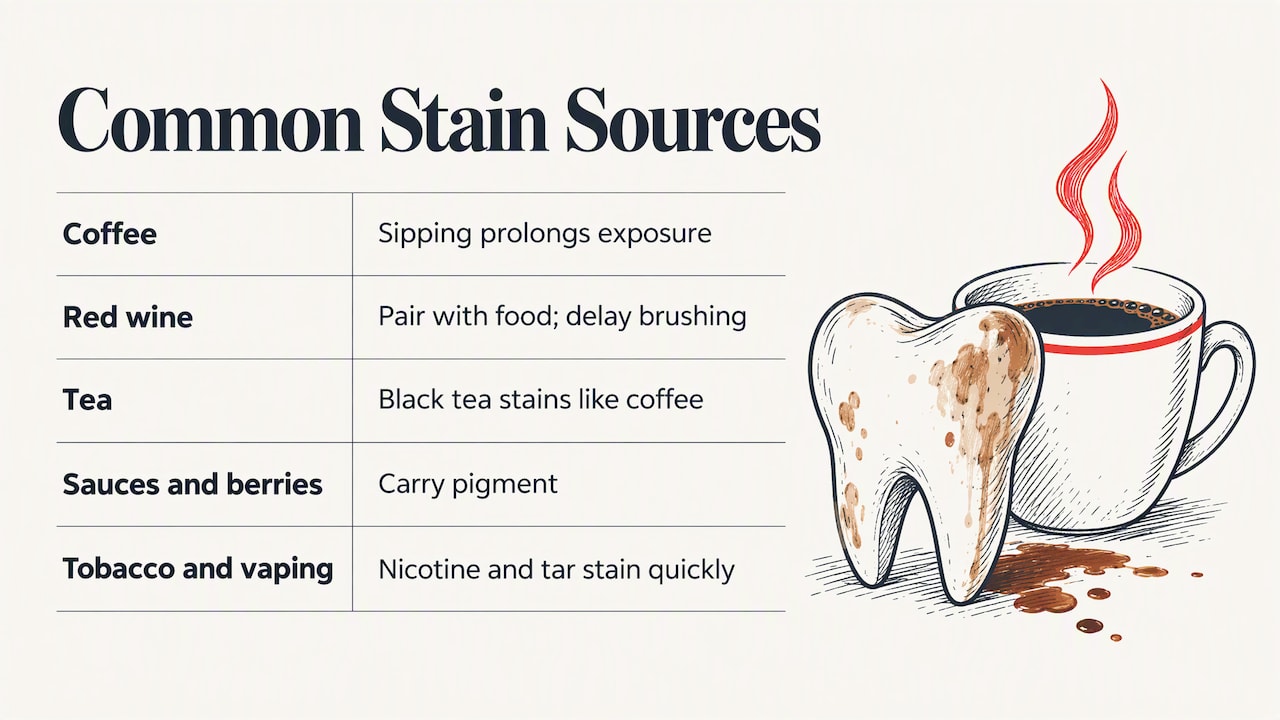
Coffee. Have it in one sitting rather than sipping for three hours. Constant sipping means constant exposure. A straw helps with iced coffee. Finish with water.
Red wine. Pair it with food, drink water between glasses, and do not brush until later. White wine is not stain-free either: it is acidic, so it can prime enamel to pick up colour from whatever comes next.
Tea. Black tea stains like coffee. Herbal teas vary, and berry or hibiscus blends are strongly pigmented.
Sauces and berries. Tomato, soy, curry and blueberries all carry pigment. You do not have to give them up. Just do not make them a daily habit in the first week.
Tobacco and vaping. Nicotine and tar stain quickly. Nicotine-stained teeth can also need repeated treatment to change noticeably, so a single session may only be the start.
Choosing toothpaste: whitening is not always whiter
Many people assume every whitening toothpaste helps maintenance. They do not. Some work by gentle polishing or by containing a low-level peroxide. Others lean on harsh abrasives, and research on staining susceptibility has found that rougher surfaces pick up stain more readily. Charcoal formulas performed poorly in those tests.
A practical approach:
- Use a fluoride toothpaste you like twice a day. This is non-negotiable for enamel health.
- If you want a whitening paste, choose a low-abrasion one and use it a few times a week rather than for every brush.
- If your teeth are sensitive, choose a sensitivity formula instead and skip the whitening paste for now.
- Be sceptical of gels, strips and powders promising dramatic results. In Australia, over-the-counter products are capped at 6% hydrogen peroxide or 18% carbamide peroxide, and stronger concentrations are for registered dental practitioners to supply. A product claiming otherwise is a red flag.
Touch-ups: when and how
The most useful maintenance idea is the top-up. A short refresher every 6 to 12 months is generally easier, cheaper and gentler than letting your teeth drift back to square one and starting again.
Top-ups can take two forms:
- A short at-home course using a suitable product, for people who prefer to keep it low-key.
- A shorter professional session for people who want the same punchy in-chair result before a big occasion.
Here is a simple plan you can adapt.
| When | What to do |
|---|---|
| Day 0 to 3 | White diet, no smoking, lukewarm food if sensitive |
| Day 4 to 7 | Reintroduce colour gradually, keep water rinses |
| Weeks 2 to 4 | Normal routine, soft brush, floss daily, fluoride toothpaste |
| Every 6 months | Dental check-up and professional clean |
| Every 6 to 12 months | Top-up whitening, timed before events if you have them |
| Any time | Rinse after staining drinks, wait an hour to brush |
If you drink a lot of coffee or wine, lean towards the six-month end. If you rarely touch either, you may stretch to 12 months or beyond.
Not sure how many sessions your teeth need to begin with? Our guide to how many teeth whitening sessions you need is a good place to start.
Re-staining: what is normal and what is not
A slight softening of the shade in the first couple of weeks is normal. Your teeth also rehydrate after the session, which changes how they look. A big drop in a month, though, usually has a cause:
- stain-heavy habits in the first week
- unaddressed plaque or tartar, which a professional clean fixes
- a rough toothpaste or aggressive brushing
- an underlying issue such as a cavity or worn enamel
If the same teeth keep darkening while others stay white, see your dentist. It may be a dental problem, not a staining problem.
Our article on common teeth whitening mistakes lists the habits that most often cut results short.
What maintenance cannot fix
Crowns, veneers, bonding and fillings do not respond to whitening gel. If you have visible restorations, they will stay their original colour while your natural teeth lighten and then slowly darken again. The Australian Dental Association also points out that whitening is not suitable for people with untreated decay or gum disease, which is why a dental check should come first. If you are not sure what is in your mouth, ask your dentist before booking.
For a deeper look at why professional supervision is worth it, read why professional teeth whitening is important. Braces wearers have their own rules, covered in when you can whiten after braces.
Treat it like any professional treatment
Whitening is not the only treatment where results depend on what you do afterwards. Skin clinics say the same thing about facials and peels: the appointment is the beginning, and the aftercare decides how long it lasts. If you like the way that idea is laid out, this guide on keeping results after a facial treatment makes the same point for skin. For teeth, the principle is the same: book the treatment, then protect it.
Our perspective on keeping a whitening result
We have performed more than 10,000 treatments since 2011, and the pattern we see is consistent. People who fuss over the first three days and then settle into a normal routine do better than people who obsess for a month and then give up. Maintenance should not feel like a diet. It should be a handful of habits you can live with.
We design our sessions around natural-looking results and minimal sensitivity, because a comfortable treatment is one people are happy to repeat. Our consultation exists to match the session to your teeth, your lifestyle and your timeline. If you are a daily coffee drinker, we would rather plan a regular top-up with you than promise a result that will never fade. Nothing does.
One more thing: use a light touch. Soft brush, gentle pressure, fluoride toothpaste. That does more for your smile than any miracle product.
— Matthew
Book a session or a top-up
We offer two in-clinic sessions: the Triple Action 60 minute session for $199 and the Ultra Bright 90 minute session for $249. Both use the highest-strength whitening gel allowed by law and are designed to keep sensitivity low. Gift vouchers are also available if you are buying for someone else. You can see the options on the SmileBar website, read how a session runs on our treatments page, or find a studio near you, including Maroochydore, Noosa, Broadbeach, Townsville, Goodwood and Richmond.
FAQ
How do I keep my teeth white after whitening?
Avoid strongly coloured food and drink for at least 72 hours, brush twice daily with fluoride toothpaste, floss daily and rinse with water after coffee or wine. Book a dental clean about every six months. Plan a top-up every 6 to 12 months to hold the shade.
Can I drink coffee after teeth whitening?
Not in the first 72 hours if you can help it, and ideally not for a week. After that, you can go back to it. Drink it in one sitting, use a straw for iced versions, rinse with water afterwards and wait about an hour before brushing.
How often should I top up my whitening?
Most people do well with a refresher every 6 to 12 months. Heavy coffee, tea or red wine drinkers and smokers may want it closer to six months. Your dentist or whitening provider can advise based on your teeth.
Do whitening toothpastes help maintain results?
Some can, but not all. Low-abrasion formulas used in moderation are fine. Highly abrasive or charcoal pastes can roughen the surface and make staining easier, so a standard fluoride toothpaste is the safer everyday choice.
Will my crowns and veneers match after whitening?
No. Restorations do not change colour with whitening gel, so they can look darker than your newly whitened natural teeth. Talk to your dentist before treatment if you have visible work on your front teeth.
Sources
This article draws on the following bodies and publications. We have not linked them out, so you can search for each by name.
- Australian Dental Association, Policy Statement 2.2.8: Teeth Whitening (Bleaching) by Persons other than Dental Practitioners
- Australian Competition and Consumer Commission, Product Safety: guidance on teeth whiteners
- Systematic review, “Prognosis in home dental bleaching”, PubMed Central, 2023
- Systematic review, “Post-Operative Sensitivity and Color Change Due to In-Office Bleaching With the Prior Use of Different Desensitizing Agents”, Cureus, 2022
- Colgate Oral Health, “How to Keep White Teeth?”
- SmileBar guides linked throughout this article
Recommended
- What to Eat After Teeth Whitening & What to Avoid
- 5 Dental Hygiene Tips Everyone Should Know
- Avoid These 14 Common Teeth Whitening Mistakes!
- How Many Teeth Whitening Sessions Do You Need?