Yes, you can walk in with stained teeth and leave noticeably whiter in a single appointment. Professional in-chair whitening is the only method that reliably delivers this, and at SmileBar it takes 60 or 90 minutes. What it can’t do is work for everyone, fix every kind of discolouration or last forever without some care from you. This guide covers how a one-visit treatment works, what it costs, who should wait, and how to protect the result.
TL;DR
- In-chair whitening is the one route that gives visible results in one visit. Home kits and strips take days or weeks.
- Our Triple Action 60 minute session is $199 and our Ultra Bright 90 minute session is $249.
- Surface stains from coffee, tea and red wine respond well. Crowns, veneers and fillings do not change colour.
- Whitening is not recommended during pregnancy or breastfeeding, or with gum disease, cracked teeth or untreated dental problems.
- Mild, temporary sensitivity is common. A consultation beforehand is how we keep it to a minimum.
Table of Contents
- What “same day” whitening really means
- Why gel strength is the whole story
- How our one-visit treatment unfolds
- 60 minutes or 90: choosing your session
- Same day versus the other ways to whiten
- What results to expect
- Sensitivity: the question everyone asks
- Who should wait or check with a dentist first
- Our perspective: why we don’t rush the part that matters
- The 48 hours after your session
- Keeping the result if you love coffee and red wine
- Planning around an event
- Where to book
- Ready for a brighter smile?
- FAQ
- Sources
What “same day” whitening really means
The phrase gets used loosely, so it helps to be exact. Same day whitening means one appointment, start to finish, with the visible change happening in the chair. You don’t take anything home to use for a fortnight, and you don’t come back for a second visit to see the effect.
The approach is simple. A trained operator protects your gums and lips, applies a strong whitening gel to your teeth, and activates it with specialised equipment. The gel lifts stain from the enamel surface. Australian health guidance from healthdirect describes professional in-chair whitening in much the same terms: a strong hydrogen peroxide gel, often used with a light, with teeth that should be whiter after one appointment.
That is different from anything marketed as “instant” in a chemist aisle or online. Those products are limited in strength by law, which is why they take longer, and the ones that aren’t limited are a problem, as we explain below.
Why gel strength is the whole story
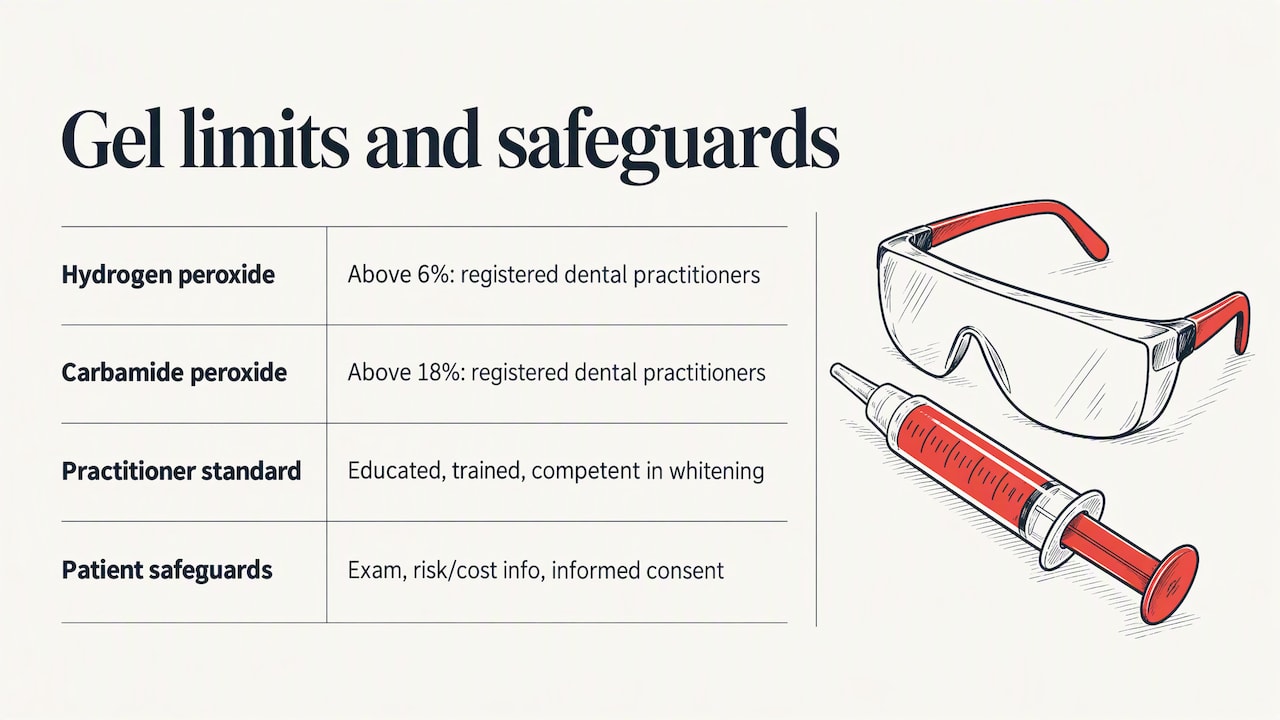
In Australia, the strength of whitening products is regulated for a reason. Under the Poisons Standard, products with more than 6% hydrogen peroxide or more than 18% carbamide peroxide are restricted to registered dental practitioners. The Australian Dental Association’s policy on whitening says that only practitioners who are educated, trained and competent in whitening should use or supply products above those levels, and that patients should receive an examination, information on risks and costs, and a chance to give informed consent.
The ACCC has also acted on this. Its Product Safety team negotiated recalls of nine home-use whitening products in 2011 after injury reports. Those reports included chemical burns to gums and mouth, blistering, ulceration, tooth sensitivity, uneven or unnaturally coloured teeth, and headaches.
The practical lesson for anyone chasing a fast result: be wary of a product that promises dramatic change at home, and be wary of any provider who can’t tell you what is in the gel or who will be applying it. Speed comes from concentration plus professional supervision, not from a bolder label.
We use the highest grade whitening gel allowed by law, and that is exactly why the treatment is done in a chair, with your gums protected and the process managed from start to finish.
How our one-visit treatment unfolds
If you’ve never had it done, the unknown is the biggest barrier. Here is the usual shape of a session. You can see our full step-by-step on the treatments page.
- Consultation. We check your teeth and talk through your goal, your history of sensitivity and any dental work you have. This is where we decide whether whitening suits you today and which session fits.
- Shade check. We note your starting shade so you can see the change afterwards.
- Protection. Your lips and gums are shielded so the gel stays on the teeth.
- Gel and activation. The whitening gel is applied and activated using our equipment, in stages across the session.
- Finish and after-care. We rinse, compare your shade and give you clear after-care instructions for the next 24 to 48 hours.
The session itself is relaxed. Most people read, scroll or just close their eyes. There is no drilling and no anaesthetic.
60 minutes or 90: choosing your session
We offer two in-clinic sessions. Both use the same approach, and the difference is how long the gel works for.
| Triple Action | Ultra Bright | |
|---|---|---|
| Length | 60 minutes | 90 minutes |
| Price | $199 one-off | $249 one-off |
| Best for | Light to moderate staining, a refresh before an event, first-timers | Heavier staining, long-term coffee or red wine habits, the whitest result we can give you in one go |
The 90 minute Ultra Bright is our signature treatment, built around getting the whitest yet natural-looking smile in one sitting. If you have years of tea, coffee or red wine behind you, or you want the strongest possible effect for a wedding or a big photo, it is the one we usually point people to. If your teeth are mostly fine and you want a lift, the 60 minute session is good value.
On the question of how many sessions you might need over time, we’ve written about it in more detail here: how many teeth whitening sessions do you need. For what a treatment costs in the wider market and why prices differ, see how much professional teeth whitening costs.
Same day versus the other ways to whiten
There are three broad routes, and the right one depends on your deadline.
| Route | Speed | Who supervises | Notes |
|---|---|---|---|
| In-chair professional treatment | One visit, 60 to 90 minutes | Trained operator | Fastest option, strongest legal gel |
| Dentist-made custom trays | Days to weeks of daily wear | Dentist | The American Dental Association notes custom-tray treatment commonly takes 6 to 28 days |
| Over-the-counter strips and kits | Often longer again | You | Lower strength, results vary |
The American Dental Association describes dentist-supervised in-office whitening as the fastest conventional route. Johns Hopkins Medicine similarly notes that in-office bleaching usually needs one visit, while over-the-counter products may not give the dramatic improvement of a professional treatment.
So if your deadline is this weekend, in-chair is the answer. If you have a month and prefer to whiten gradually on your own schedule, take-home trays from a dental professional are a sensible alternative. For the busy professional or the person with an event on Saturday, a single session is the point.
What results to expect
We don’t promise a particular number of shades, because teeth differ. Starting colour, the type of stain and your enamel all matter. What we can say is that surface stain from coffee, tea, red wine, smoking, spices, berries and beetroot, which healthdirect lists as common culprits, is what in-chair whitening handles best.
A few honest limits:
- Crowns, veneers and fillings do not whiten. If you have visible restorations on your front teeth, your natural teeth may end up brighter than the work. Tell us before you book so we can talk it through.
- Deep internal discolouration may not respond. Colour change after an injury, or staining linked to certain medications such as tetracycline, usually sits inside the tooth and external whitening may do little.
- Natural-looking is the goal. We aim for the whitest smile that still looks like yours, not a flat white that draws attention.
If you want a sense of what other clients experienced, our testimonials describe notable shade improvements, and we have carried out more than 10,000 procedures since 2011. Your own result is still individual, and we’ll tell you at the consultation what is realistic.
Sensitivity: the question everyone asks
Strong whitening gel can make teeth sensitive for a short time. The American Dental Association’s review reports transient mild to moderate sensitivity in up to two-thirds of people during early bleaching, and describes it as a recognised temporary effect rather than a sign the treatment failed.
We treat sensitivity as the thing to design around. It is a core focus of how we work: the consultation asks about your history, we tailor the session to you, and our after-care keeps you comfortable in the first couple of days.
A straight answer for people who already have sensitive teeth: healthdirect says professional whitening is not recommended for people with sensitive teeth, and that is a reason to raise it with us before you book rather than after. We’ll tell you honestly whether to go ahead, wait, or see your dentist first. If cold sensitivity or mouth irritation lasts more than a day or two after treatment, healthdirect advises contacting the professional who treated you, and you should do the same with us.
Who should wait or check with a dentist first
Same day does not mean skipping the checks. Healthdirect says whitening is not recommended if you:
- are pregnant or breastfeeding
- have gum disease
- have cracks or holes in your teeth
- have untreated dental problems
If any of those apply, see your dentist first. Whitening gel is never a substitute for treating decay, cracks or gum disease, and sorting those out first is better for your teeth and your result. If you’re breastfeeding and wondering about a gift voucher or an event next month, the sensible plan is to wait until it’s appropriate and book later. A voucher is a good way to do that.
Our perspective: why we don’t rush the part that matters
People come to us with a deadline, and we respect that. A wedding, a job interview, a holiday, a milestone birthday. Our job is to make a one-visit treatment genuinely possible without cutting corners on the things that keep it safe and comfortable.
In our experience, the best results start before the gel goes on. Five minutes of questions about your coffee habit, your history of sensitivity and any dental work tells us which session to recommend, and sometimes whether to recommend one at all. We would rather tell you to wait than treat teeth that aren’t ready.
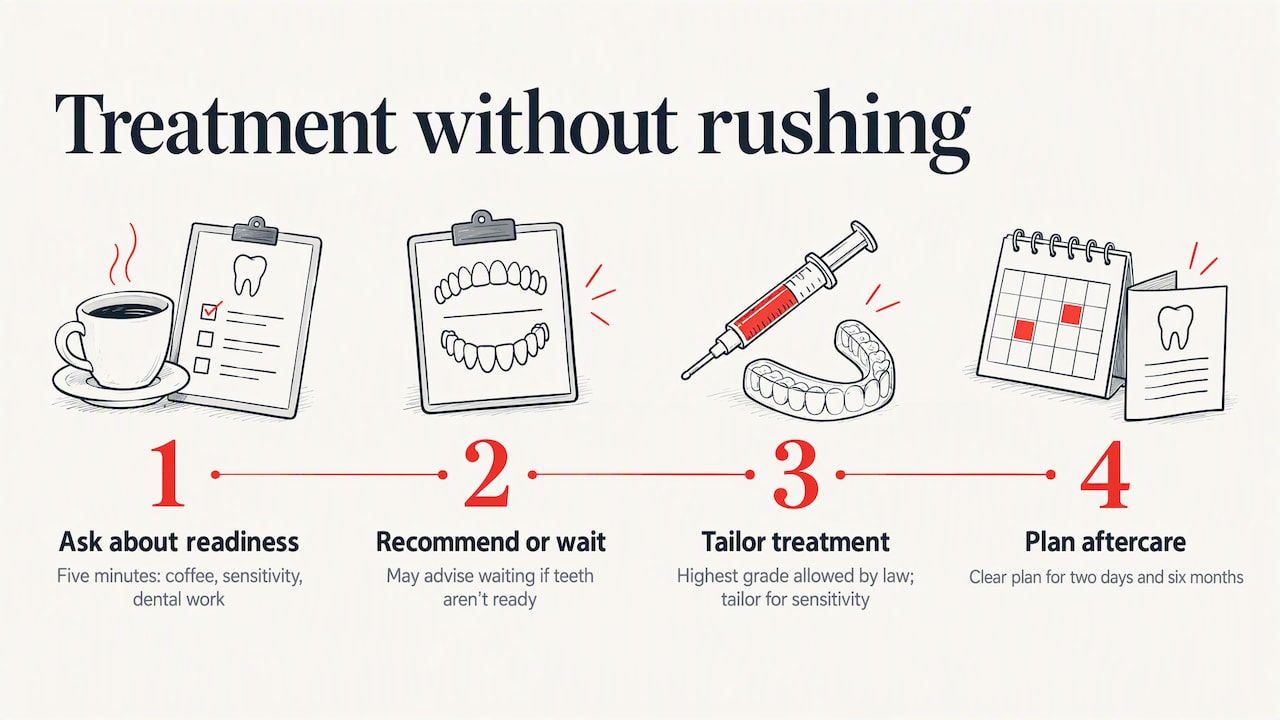
We also think plain talk about strength matters. We use the highest grade gel allowed by law, because that is what produces a strong result in one session, and we keep sensitivity as low as we can by tailoring the treatment. We operate with Australian consumer law in mind, and we would encourage anyone shopping around to ask any provider the same questions: what concentration, who applies it, and what happens if something goes wrong.
Finally, the result is partly in your hands afterwards. We’d much rather you leave with a clear plan for the next two days and for the next six months than with a bright smile that fades by Christmas.
— Matthew
The 48 hours after your session
Teeth are more porous right after whitening, so what you eat and drink in the first day or two counts. Our simple rules:
- Stick to light-coloured foods and drinks: chicken, rice, pasta, white fish, water, milk.
- Skip coffee, tea, red wine, soy sauce, tomato-based sauces, berries and beetroot for the first 48 hours.
- Don’t smoke. Healthdirect lists smoking among the main external causes of staining.
- Use a straw for any drink that stains, if you do have one.
- Keep brushing and flossing daily, as healthdirect recommends.
We’ve put together a longer list in our guide to what to eat after teeth whitening and what to avoid. It’s worth saving to your phone before your appointment.
Keeping the result if you love coffee and red wine
You don’t have to give up your flat white. Healthdirect’s advice for staining drinks is practical: rinse with water afterwards. Add daily brushing and flossing and a regular dental check-up, and the result lasts longer.
How long it lasts depends on your habits. A heavy red wine drinker who smokes will see colour return sooner than someone who drinks the occasional coffee. Many clients book a top-up when they notice their shade slipping, and we sell after-care and at-home whitening products for maintenance between visits. For general habits that protect your smile, our post on five dental hygiene tips everyone should know is a good place to start.
Planning around an event
If you’re whitening for a specific date, timing helps.
- Wedding or photoshoot: book a few days before, not the morning of, so any mild sensitivity has settled and you’ve had time to follow the after-care. Our wedding day smile tips cover this in more detail.
- Job interview or presentation: the day before, or the same week, is fine for most people.
- Holiday: whiten before you go, and be careful with the first 48 hours of coffee, wine and cocktails.
- Gift for a partner: a gift voucher lets them choose a date that suits, and lets us do the consultation first.
Same day describes the treatment, not necessarily the booking. Availability depends on the clinic and the day, so check the location page for the time you want rather than assuming a walk-in slot.
Where to book
We treat clients in major cities and regional centres across Australia. Pick your nearest clinic:
- Sydney, including Darlinghurst on Bathurst Street
- Melbourne, including Richmond
- Perth
- Adelaide, including Goodwood
- Gold Coast: Broadbeach
- Sunshine Coast: Noosa and Maroochydore
- Townsville
Ready for a brighter smile?
Our Triple Action 60 minute session is $199 and our Ultra Bright 90 minute session is $249, both one-off prices with no course to commit to. We also sell gift vouchers if you’re buying for someone else. See the options and book on the SmileBar home page.
FAQ
Is same day teeth whitening safe?
For most healthy adults, professional whitening is considered safe when it follows an assessment by a dental professional or properly trained operator, as healthdirect advises. It is not recommended during pregnancy or breastfeeding, or with gum disease, cracked teeth or untreated dental problems. Mild, temporary sensitivity is common.
How much does same day teeth whitening cost at SmileBar?
The Triple Action 60 minute session is $199 and the Ultra Bright 90 minute session is $249, each a one-off price. Prices at other providers vary widely, so compare what is included and who applies the gel, not just the number.
How long do the results last?
There is no fixed answer, because it depends on your diet, whether you smoke and how well you look after your teeth. Rinsing with water after coffee, tea and red wine and brushing and flossing daily helps. Many people book a top-up once their shade begins to fade.
Can I whiten my teeth if I have crowns, veneers or fillings?
You can, but those restorations will not change colour, so they may look darker next to your whitened teeth. Mention any visible dental work when you book so we can talk through what to expect at the consultation.
Is there something I can do at home that works in one day?
Not to the same degree. Home products sold to consumers are limited in strength by Australian regulation, so they work more slowly. Products stronger than the legal limit have caused injuries and recalls, so we’d steer you away from them.
Sources
This article draws on guidance from the following bodies. Search their names to read the original pages.
- healthdirect (Australian Government-funded), Teeth whitening, published 13 June 2025
- Australian Dental Association, Policy Statement 2.2.8, Teeth whitening and bleaching by persons other than dental practitioners
- ACCC Product Safety, report on action against unsafe teeth whiteners
- American Dental Association, Whitening review
- Johns Hopkins Medicine, Teeth whitening, 2 June 2025
Recommended
- Teeth Whitening Costs in Australia for 2026
- Salon vs Dentist vs At-Home Teeth Whitening
- In-Chair, Professional Teeth Whitening Perth
- Professional, In-Chair Teeth Whitening Melbourne