Natural looking teeth whitening means lightening your teeth by a few believable shades, evenly across the smile, so people notice you look fresh rather than notice your teeth. The most reliable way to get there is a professional session at the strength the law allows, followed by habits that protect the result. Home remedies such as baking soda, charcoal and lemon are slow, inconsistent and can wear down enamel.
This guide explains what a natural white shade actually is, why your teeth are not the same colour as anyone else’s, what a professional treatment can and cannot do, and how coffee and red wine drinkers can keep a brighter smile from fading quickly.
TL;DR
- A natural result is a lift of a few shades that suits your own tooth colour, not the brightest white on a chart. Even a change of two or three shades is clearly noticeable.
- Professional whitening is the most predictable route. Strong gels (above 6% hydrogen peroxide) are restricted in Australia, so the treatment you choose matters.
- Kitchen remedies like charcoal, lemon and baking soda are not a safe shortcut, and frequent use can damage enamel.
- Coffee, tea and red wine stain, but good daily habits and a yearly top-up keep the shade steady.
- Our Triple Action 60 minute session is $199 and our Ultra Bright 90 minute session is $249.
Table of Contents
- What “natural looking” actually means
- Why your teeth are the colour they are
- Do natural remedies give a natural look?
- Why professional whitening looks more natural
- Setting a realistic, natural target
- Sensitivity, safety and who should wait
- Keeping the result: coffee, tea and red wine
- Is whitening or a veneer better for a natural look?
- Book a natural-looking whitening session
- Who natural-looking whitening suits best
- FAQ
- Sources
What “natural looking” actually means
Nobody has teeth the colour of printer paper. Healthy, stain-free teeth range from a very light white through to creamy yellow and even a slightly reddish-brown tone. A natural result sits inside that range and, importantly, matches the rest of your face: your skin tone, the whites of your eyes and your age.
Three things tend to give away an overdone whitening job:
- A flat, uniform colour. Real teeth are slightly different from front to back. Canines are usually a touch deeper than incisors, and the edges of front teeth are often a little translucent.
- A shade out of step with your eyes and skin. A very stark white looks harsh against a warm complexion.
- Patchiness. Uneven results happen when the whitening agent is not spread evenly or when existing fillings and restorations do not change colour.
The goal is a smile where friends say you look well-rested, not one where they ask what you had done.
Why your teeth are the colour they are
Tooth colour is not just a matter of how clean your teeth are. Dental education resources explain that the natural colour comes from the thickness and translucency of the enamel, the colour of the dentine underneath and, when staining is absent, your genetics. Different tooth types typically carry different shades, which is why a canine rarely matches an incisor exactly.
Age plays a part too. Australian dental experts quoted in the national press point out that older people have proportionally more dentine than enamel, which makes teeth look naturally darker, and that because everyone has a mix of tooth colours, some teeth respond to whitening better than others.
That has a practical meaning for you. If your teeth sit on the warmer, yellower side naturally, a very pale target may be out of reach, and chasing it would not look natural anyway. A sensible target is the lightest shade that still suits your teeth.
How dentists describe shade
A popular shade guide used by dental professionals who want a natural match has 16 standard hues, grouped in letter families (A, B, C and D). You do not need to memorise it. What matters is the idea: shade is measured against a scale, and a good provider will tell you where you are starting from and where a realistic finish line sits.
One commonly cited rule of thumb is that a move of two or three shades is enough to make a noticeable difference. Anything beyond that depends on your natural tooth colour, what caused the stains and how stubborn they are. If you want to see what shade changes look like in practice, our page on teeth whitening before and after results sets out what to expect.
Do natural remedies give a natural look?
It is tempting to try the pantry first. Searches for natural whitening turn up baking soda, coconut oil pulling, charcoal, strawberries, banana peel and lemon. Here is the reasoned view.
- Baking soda toothpaste is mildly abrasive and may lift some surface stain. It does not change the underlying colour of your teeth.
- Oil pulling is popular, but it is not a proven whitening method.
- Charcoal is the one to skip. The American Dental Association has stated there is no evidence that charcoal dental products are safe or effective for teeth.
- Lemon and other acidic fruit can soften the enamel surface. Healthdirect, the Australian government health service, notes that some research suggests fruits and baking soda may help whiten teeth, but that using them often may damage teeth, and it recommends speaking to a dental professional first.
The common thread is abrasion and acid. Wear away enamel and the softer, yellower dentine underneath shows through, which is the opposite of what you want. A whitening routine that dulls the surface of your teeth does not look natural, it looks tired.
What does help, and is entirely natural, is everyday care: brushing twice a day for two minutes, cleaning between your teeth daily, cutting back on staining drinks, not smoking and having regular check-ups and cleans. These habits protect any result, whichever route you take. Our guide on the importance of regular dental check-ups covers why the cleaning side matters.
What about whitening toothpaste?
Whitening toothpastes help remove or prevent stains on the outside surface of teeth. The Australian Dental Association notes they do not usually make a large difference to the actual colour of teeth, whereas in-chair professional whitening uses a stronger gel during an appointment. Think of toothpaste as maintenance, not transformation.
Why professional whitening looks more natural
The key difference is control. A professional session works on teeth that have been checked and prepared, with the gel applied evenly and for a measured time, so the colour lifts together instead of in patches.
Preparation matters more than most people expect. Dental experts explain that stains and saliva act as barriers to bleaching agents, which is why external stains are removed before whitening begins, to give the gel the best chance of working evenly.
The legal side, in plain words
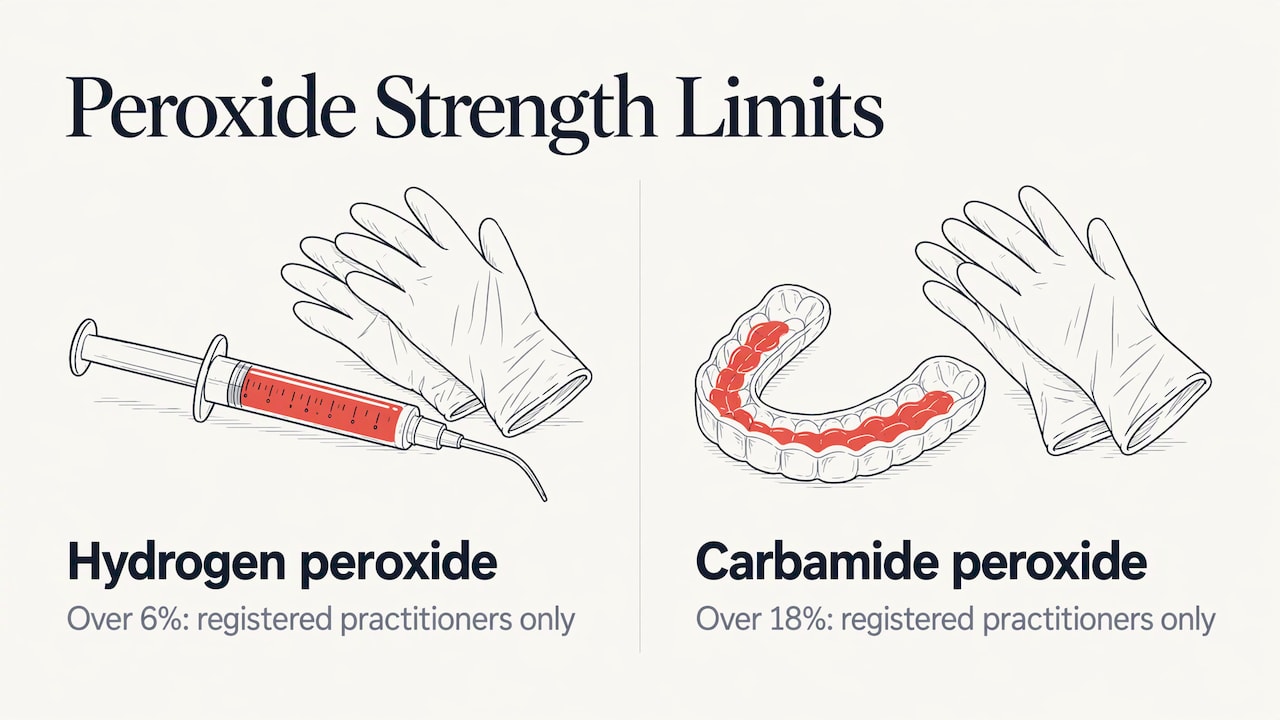
In Australia, products above certain strengths are restricted. Under the Dental Board of Australia’s guidance, high-concentration products (over 6% hydrogen peroxide or 18% carbamide peroxide) can only be used or supplied by registered dental practitioners, who must also comply with the Board’s guidelines for non-surgical cosmetic procedures, its code of conduct, medicines and poisons laws and consumer law. The Australian Dental Association’s policy statement takes the same line and describes peroxide whitening as safe and effective when done by or under the supervision of a dentist and according to professional directions.
That is why we describe our approach as using the highest-grade gel permitted by law, and why we pay close attention to Australian consumer law requirements. If you want to understand how salons, dentists and take-home kits differ, our comparison of salon vs dentist vs at-home teeth whitening goes through it, and why professional whitening matters explains the thinking behind our approach.
What a session looks like at SmileBar
Since 2011 we have carried out over 10,000 whitening procedures, and every visit starts with a consultation so the session can be tailored to you. Our focus is on keeping sensitivity to a minimum while achieving a bright but natural-looking smile. You can see the steps on our simple whitening treatment steps page.
We offer two sessions:
| Session | Length | Price |
|---|---|---|
| Triple Action | 60 minutes | $199 |
| Ultra Bright | 90 minutes | $249 |
The Ultra Bright session is our intensive option for people who want the most visible lift in a single visit. The Triple Action session suits those who want a clear, fresh improvement in a shorter appointment. If you are comparing what whitening typically costs, our page on how much professional teeth whitening costs gives more context.
Setting a realistic, natural target
Before booking, it helps to think about three questions.

What is my starting shade? Warm, yellow-toned teeth usually respond well to whitening. Teeth with grey or brownish tones can respond less predictably, and results vary from person to person.
What caused the stains? Surface stains from coffee, tea and red wine are the most common reason people book. Deeper discolouration is more stubborn. In some cases, such as a single darkened tooth, a different approach is needed; our page on whitening a dead tooth explains internal bleaching.
What do I already have in my mouth? Fillings, crowns and veneers do not whiten like natural tooth. Whitening your natural teeth can leave them lighter than existing restorations, so mention these at your consultation. Failing fillings can also cause uneven results, according to Australian Dental Association policy on do-it-yourself kits.
Keep the filter in perspective
Photo and video filters have shifted what many people think normal teeth look like. The federal president of the Australian Dental Association has said these filters have warped perceptions of tooth whiteness and that tooth colour does not necessarily indicate tooth health. A natural-looking result is measured against real life, in daylight, not against a filtered selfie.
Sensitivity, safety and who should wait
The most common side effects of professional whitening are temporary tooth sensitivity and soft-tissue irritation during or just after treatment, according to the Australian Dental Association. That is why our approach centres on minimising sensitivity, and why the consultation comes first.
Healthdirect advises that whitening is not recommended if you:
- are pregnant or breastfeeding
- have sensitive teeth
- have gum disease
- have cracks or holes in your teeth
- have untreated dental problems
If any of these apply, see your dentist first and treat the underlying issue. If you are expecting, read our guide on why dentists say to wait on pregnancy teeth whitening.
Why DIY strong bleach is the risky path
Australian Dental Association policy lists risks from do-it-yourself whitening kits that include stomach problems, mouth ulcers, gum damage and nerve damage where there are cavities. The association’s federal president has also warned about social media whitening trends, saying that the wrong bleach concentration can kill a tooth and usually calls for root canal treatment. Healthdirect likewise says kits or whitening by someone who is not a qualified dental professional can put you at risk of harm.
If you do want to use a take-home product, our guide on the safe way to use at-home teeth whitening explains how to do it properly.
Keeping the result: coffee, tea and red wine
You do not have to give up your morning coffee. You do need a plan.
Teeth are most receptive in the first day or two after whitening. Teeth also take around two weeks to settle into their final whitened shade, according to the University of Rochester Medical Center. A Brazilian laboratory study found that contact with coffee from 24 hours after in-office bleaching, and with wine from 24 and 72 hours, affected how quickly the whitening effect developed, and that the effect reversed after a week in the groups tested. The takeaway is simple: be strict about dark drinks in the first days.
A simple routine
- For the first 48 hours, stick to light-coloured food and drink. Our list of what to eat after teeth whitening and what to avoid makes this easy.
- Rinse with water after coffee, tea, red wine or anything else that can discolour teeth. Healthdirect recommends this.
- Brush twice a day and floss daily. Dental experts say this, along with a check-up and clean about every six months, keeps stains at bay.
- Use a stain-prevention toothpaste. A daily anti-stain whitening toothpaste can help keep surface stains from building up between sessions.
- Do not smoke. Tobacco is a major cause of staining.
- Plan a yearly top-up. Most people need a touch-up about once a year after professional whitening, and the shade fades faster if you keep drinking dark beverages.
For a fuller routine, see our guide to teeth whitening maintenance.
Is whitening or a veneer better for a natural look?
Veneers are a different tool. They are made from porcelain or composite, resist stains well and can look very natural, but they are a restorative treatment that alters the tooth, not a brightening treatment. If your goal is simply to lift the colour of healthy natural teeth, whitening is the lighter-touch route. If you want to change shape, close gaps or mask deep discolouration, a dentist can talk you through restorative options.
Book a natural-looking whitening session
If you want a brighter smile for an event, a milestone or just for yourself, we can help you choose the right session. Our Ultra Bright 90 minute session is $249 and our Triple Action 60 minute session is $199, both using the highest-grade gel allowed by law and designed with minimal sensitivity in mind. We also sell gift vouchers, which suit couples and anyone shopping for a special occasion.
You can view sessions and book on the SmileBar website. We have locations in Noosa, Maroochydore, Broadbeach, Townsville, Cairns and Perth.
Who natural-looking whitening suits best
- Busy professionals who want a quick, noticeable lift in a single lunch-break-sized appointment, without a multi-week routine.
- People preparing for an event such as a wedding, graduation or job interview, who want to look polished without looking altered. Book at least a couple of weeks ahead so the shade has time to settle.
- Coffee and red wine drinkers whose teeth have dulled gradually and who want to reset the shade, then protect it.
- Gift-givers choosing a voucher for a partner or friend who has mentioned wanting a brighter smile.
FAQ
How do I make my teeth look whiter naturally?
The safest natural steps are daily habits: brush twice a day for two minutes, clean between your teeth, rinse with water after coffee, tea and red wine, and avoid smoking. Regular check-ups and cleans remove surface stain. These habits keep teeth looking their best but will not change your underlying tooth colour much.
What is the fastest way to whiten teeth and keep them looking natural?
Professional in-chair whitening is the quickest route to a visible change, often in a single appointment. Surface stains are removed first so the gel works evenly. Choosing a modest shade lift that suits your natural tooth colour is what keeps the result looking natural.
Do baking soda, charcoal or lemon work for natural whitening?
They are not recommended as a regular whitening method. Baking soda is mildly abrasive and charcoal has no evidence of being safe or effective. Acidic fruit can soften enamel. Healthdirect advises speaking to a dental professional before trying natural ingredients, because frequent use may damage teeth.
How long does a natural-looking whitening result last?
It depends on your habits. Teeth settle into their shade over about two weeks, and most people top up about once a year. If you drink a lot of coffee, tea or red wine, the shade fades faster, so rinsing, brushing and regular cleans help it last.
Sources
- Teeth Whitening Before and After: What Results to Expect
- Teeth Whitening Maintenance: How to Keep Your Results
- Salon vs Dentist vs At-Home Teeth Whitening
- Steps for Our Simple Teeth Whitening Treatments
- The Safe Way to Use At-Home Teeth Whitening
Recommended
- 5 Simple Ways to Whiten Your Teeth Naturally
- The Power of a Glowing Smile: 6 Benefits of Teeth Whitening
- Why Choosing A Professional Teeth Whitening Is Important
- Teeth Whitening Maintenance: How to Keep Your Results


