Yes, you can whiten your teeth around Invisalign, and the most predictable way is a professional in-clinic session timed to your treatment plan. Your aligners come out for the appointment, the gel goes onto the teeth you can actually see, and you don’t depend on a tray that was built to move teeth rather than hold gel. Our Ultra Bright 90 minute session is $249 and our Triple Action 60 minute session is $199, both booked at smilebar.com.au.
This guide is for people who drink coffee or red wine, have a wedding, event or big meeting coming up, or want a gift that lands well, and who are partway through (or just finished) Invisalign.
TL;DR
- Whitening during Invisalign is possible, but the results are usually more even once treatment is finished and your teeth are in their final position.
- Attachments (the small tooth-coloured bumps bonded to your teeth) and fillings do not whiten, so shade differences can show.
- High-strength whitening products are restricted in Australia to registered dental practitioners, so skip anything strong sold online.
- An in-clinic session of 60 or 90 minutes whitens all the visible tooth surface in one visit, with no tray fit to worry about.
- Tell your Invisalign provider before you book, so the timing suits your plan.
Table of Contents
- Why people whiten around Invisalign in the first place
- Can you whiten teeth while wearing Invisalign?
- During or after treatment: which is better?
- What to expect: results and limits
- What Australian rules mean for you
- Sensitivity and gum comfort
- A simple plan for Invisalign wearers
- Why an in-clinic session suits Invisalign wearers
- Book your session
- What if one tooth is darker than the rest?
- FAQ
- Sources
Why people whiten around Invisalign in the first place
Invisalign straightens your teeth, but it does nothing for their colour. Clear aligners are worn for most of the day, and you take them out to eat and drink. That is a good habit for avoiding stains, but plenty of people still finish treatment with the same yellow-grey tinge they started with, or notice it more because the teeth now look so neat.
There is also a practical pull. Many people choose to start whitening when a date approaches: a wedding, a job interview, a milestone birthday, a holiday. Treatment length rarely lines up with those dates, so the question becomes whether you can whiten now or should wait.
Coffee, tea and red wine drinkers face a particular problem. Aligners must come out for anything other than water, which means a trapped coffee film is less of a risk during treatment. Once the aligners are gone for good, though, your daily habits go back to normal and the surface staining returns. Planning whitening for the end of treatment, with a sensible aftercare routine, gives the result the best chance of lasting.
Can you whiten teeth while wearing Invisalign?
You can whiten during treatment, but you can’t whiten through the aligners while they sit on your teeth in the usual way. Aligners fit snugly, and the usual advice is that gel and everyday aligner wear do not mix. If gel is trapped under an aligner you can end up with gum irritation, and you may not get an even coating.
A 2022 systematic review of bleaching during orthodontic treatment, published in the journal Applied Sciences, looked at studies on clear aligners used as bleaching trays. It found only three studies that met its criteria and concluded that the evidence is limited and that larger, longer-term clinical trials are needed. Within those studies, tooth shade did improve. One 28-patient Invisalign study reported a significant shade change at two and four weeks.
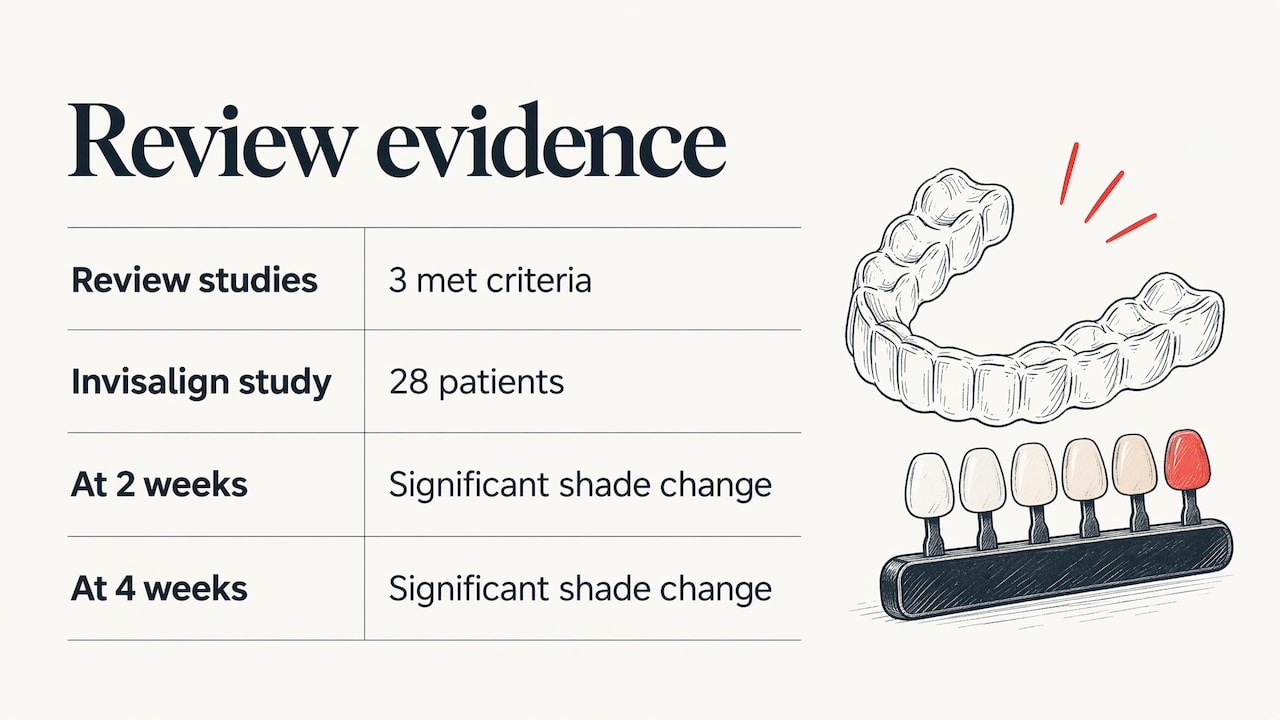
So the honest summary is this: it can work, the research is still thin, and the review concluded that it should be done under professional supervision.
Using your aligner as a whitening tray
This is the question behind “teeth whitening with retainers” too. A retainer or aligner can in principle hold gel against the teeth, because it is already moulded to them. The catch is that aligners are designed to move teeth, with small gaps and pressure points built into each stage. Gel can pool in some places and be missing in others.

Some clinics advise against using your last aligner as a whitening tray at all. If you want take-home whitening, the approach with the best track record is a tray made for that purpose, supplied by a dentist after an examination. A dental practitioner can tell you which approach suits your teeth and your stage of treatment. If you want an overview of how aligners and whitening fit together, this explainer on whitening with Invisalign and when to start covers the basics.
What lab testing says about aligner material
A 2023 laboratory study tested 22 unused Invisalign aligners and 144 specimens after two weeks of exposure to 10% carbamide peroxide, a common bleaching agent. It found reduced hardness and increased surface roughness, while the other physical properties measured showed no statistically significant differences. The authors concluded that the gel did not cause excessive distortion or degradation under their test conditions, and they called for clinical trials. Lab results do not prove how every product behaves on every patient, which is another reason to discuss the plan with your provider before you begin.
During or after treatment: which is better?
For most people the answer is after, or at a clearly planned point near the end. The reasons are practical:
- Your teeth are still moving. The 2022 review notes that severe crowding can compromise fit and result when you bleach during treatment, and some studies suggest waiting until later alignment or finishing, particularly where attachments or a uniform shade matter.
- Attachments get in the way. Attachments are bonded to the tooth surface, and gel will not whiten them. The review reports that peroxide can reach tooth structure beside attachments, but the evidence is limited. Once they are removed, the tooth underneath may be a different shade from the area around it.
- Overlapping teeth hide surfaces. Teeth that are still crooked have overlapping edges that gel cannot reach evenly. Once they are straight, every surface is exposed, and the shade comes out far more uniform.
- One decision at a time. Finishing your Invisalign first means you choose your whitening shade against your final smile, not a work in progress.
If you have a dated event in the middle of treatment, whitening during Invisalign is still possible. Ask your Invisalign provider whether your tooth position allows it and whether they want a gap between attachment stages and the whitening session.
Why teeth can look more yellow after Invisalign
This is a common search, and there are usually simple explanations. Straighter teeth catch the light differently. Attachments leave a small patch of bonding material residue or a visibly different shade where they sat. Stains that were hidden by crowding or masked by the aligner can show up once the aligner is gone. And dentine, the layer underneath the enamel, shows through more as the enamel thins naturally with age. A professional whitening session addresses the staining on the enamel, which is the usual cause of that yellow look.
What to expect: results and limits
Whitening results vary from person to person. The Australian Dental Association NSW says outcomes can range from subtle to dramatic, and may be uneven or not visible at all. It also points out that fillings, crowns and other restorative materials do not change colour with bleaching. If you have a front-tooth filling or a veneer, it will not match a newly whitened tooth, and you may want to have it reviewed with your dentist before you start.
Two practical tips:
- Whiten after attachments are removed, so you see the true shade of the tooth surface that was covered.
- Check your restorations. Any filling in the smile zone can change how the final result looks.
You can see typical outcomes in our guide on teeth whitening before and after, and the before teeth whitening preparation guide walks through what to do the week before your appointment.
What Australian rules mean for you
The Dental Board of Australia says only registered dental practitioners may use or supply high-concentration whitening products, meaning more than 6% hydrogen peroxide or more than 18% carbamide peroxide. The Australian Dental Association’s policy adds that consumer products at or below those concentrations may be sold directly to consumers only under the conditions of the Poisons Standard, including safety labelling.
Three things follow for you:
- Strong gels sold online or through a beauty counter without a dental practitioner are not a safe shortcut, particularly inside an aligner that holds the gel against your gums for hours.
- A dental practitioner should assess your teeth before home-use products are supplied. The Dental Board says that assessment includes an examination and a look at your history.
- Whitening should follow an examination, with risks, costs and realistic expectations explained and your consent recorded. The Australian Dental Association’s policy sets out that approach.
SmileBar uses the maximum legal-strength whitening gel, and our treatments are set up with Australian consumer law in mind. If you have gum recession, existing dental problems or an unusual history, see your dentist first. That is also the right call if you are pregnant, and our page on pregnancy teeth whitening explains why dentists suggest waiting.
Sensitivity and gum comfort
The ADA NSW information sheet warns that whitening can cause irritation or burns to exposed tissues and inflammation of the dental pulp, the soft centre of the tooth. In the 2022 review, the one reported case of sensitivity was a participant with pre-existing gum recession, and it settled once the exposure to carbamide peroxide was reduced to under eight hours.
A few points matter if you wear Invisalign:
- Orthodontic movement can leave teeth tender for a few days after each new set of aligners. Don’t stack a whitening session on top of a fresh tray change, or you won’t know which one is causing the zing.
- Gum recession or worn enamel raises the odds of sensitivity. Mention it when you book.
- The ADA NSW advises caution when heat or other energy is used to speed bleaching, because of the risk to the pulp and soft tissue.
Sensitivity is the thing we design our sessions around. Our focus is on minimising it, and we tailor the session after a consultation. For more detail, read whitening for sensitive teeth, does teeth whitening hurt and the common causes of tooth sensitivity.
A simple plan for Invisalign wearers
Here is a sequence that works for most people.
- Talk to your Invisalign provider. Ask whether your tooth position and attachments allow whitening now, or whether to wait until finishing.
- Fix the dates backwards. If you have a wedding or big event, book whitening at least a week before it, so you have time to settle any sensitivity and take a few photos.
- Brush and floss as usual before your appointment. Our preparation guide has the full list.
- Book an in-clinic session. Take the aligners out, have your teeth whitened, and let the clinician talk you through the shade.
- Follow the first 48 hours of aftercare. That is when the teeth are most prone to picking up colour. See what to do in the first 48 hours and what to eat and avoid after whitening.
- Put your aligners or retainer back in as directed by your provider. Clean them well before they go back in.
- Wait before repeating. Frequent top-ups raise the risk of irritation. See how often to whiten.
Why an in-clinic session suits Invisalign wearers
Busy people have a reasonable instinct here: they want the least fuss for the best result. Take-home routines mean daily wear time, working out tray fit, and avoiding gel contact with your gums for days or weeks. An in-clinic session condenses that into a single appointment in which the clinician applies the gel to the visible tooth surface.
It also fits real calendars. Our lunch break whitening page explains what you can do in 60 to 90 minutes, and same day whitening covers what to expect on the day. If you and a partner are both getting ready for an occasion, couples’ whitening lets you share the appointment instead of swapping trays.
As for strips and DIY kits, they are made for flat, unobstructed surfaces and are not designed around attachments or aligners. If you are weighing them up, our page on whitening strips covers what to know before you buy.
Book your session
Our Ultra Bright 90 minute session is $249, our intensive option aimed at the whitest, natural-looking result. The Triple Action 60 minute session is $199 and suits a tighter schedule. Both use the highest-grade whitening gel allowed by law and advanced equipment, and a consultation shapes the session to your teeth. We have performed over 10,000 procedures since 2011.
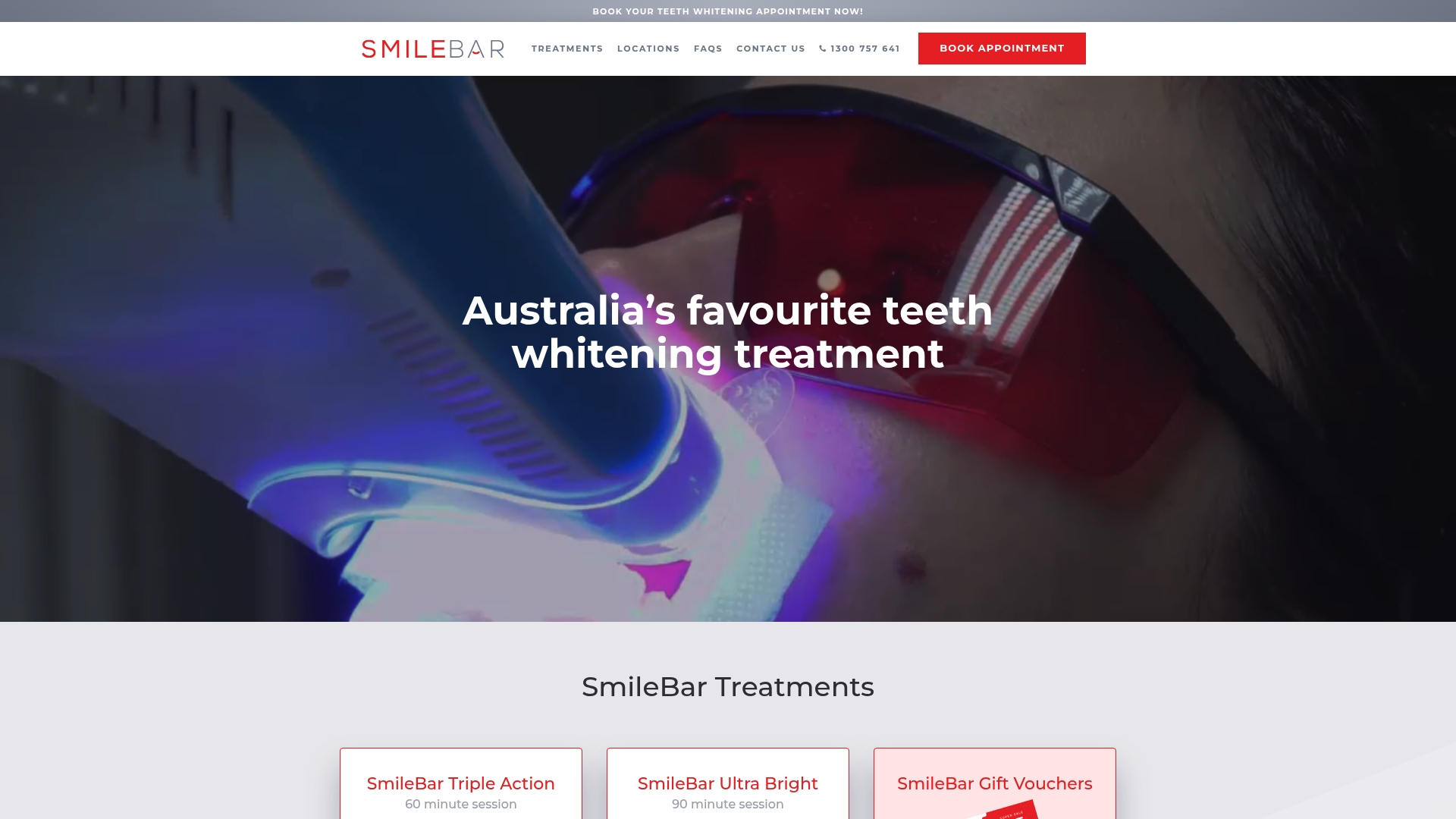
See our treatments for the steps, or book on smilebar.com.au. We have studios in Adelaide, Townsville, Maroochydore, Noosa and Broadbeach, and you can see the local pages for Adelaide, Townsville, Maroochydore, Noosa and Broadbeach. SmileBar gift vouchers are also available for anyone who wants to give a brighter smile as a present.
What if one tooth is darker than the rest?
A single dark tooth is a different problem from general staining. If a tooth has had root canal treatment, it can darken from the inside, and surface whitening will not reach that discolouration. Our page on dead tooth whitening explains internal bleaching and when a dentist is the right first call. Mention a dark tooth to your Invisalign provider as well, since it can affect how you plan the finish of your treatment.
FAQ
Can I whiten my teeth with Invisalign?
Yes. Many people whiten during treatment, but results tend to be more even once your teeth are in their final position and attachments are off. Ask your Invisalign provider about timing for your case, and book a professional session so the gel goes where it should.
Can I use my Invisalign aligners as whitening trays?
Aligners are designed to move teeth, not to hold gel evenly. A 2022 review found the research on this is limited and concluded that it should be done under professional supervision. A tray made for whitening and supplied by a dentist is the usual route for home use.
Does whitening work on attachments and fillings?
No. Attachments, fillings, crowns and veneers do not change colour with bleaching, according to the Australian Dental Association NSW. Once attachments are removed, the tooth underneath may be a different shade, so whitening after treatment gives you the clearest picture.
How long should I wait between finishing Invisalign and whitening?
There is no single rule, and your provider can advise on your case. Many people book whitening once attachments are off and any tenderness from the last aligners has settled, which is often within a few days to a couple of weeks.
Will whitening make my teeth sensitive with aligners?
Some people notice brief sensitivity, especially with gum recession or worn enamel. Tell the clinician before your session so it can be tailored, and avoid whitening straight after a new set of aligners if your teeth feel sore.
Sources
Recommended
- Before Teeth Whitening: How to Prepare, Step by Step
- Teeth Whitening: Why Monthly Repeat Treatments Raise Irritation Risk
- When Can You Whiten Teeth After Braces?
- Teeth Whitening Aftercare: What to Do in the First 48 Hours